7 Self-Care Practices for Every Area of Your Life
In today’s fast-paced world, self-care holds greater significance than ever before.
We juggle work, family, social commitments, and personal goals, often neglecting our well-being in the process.
It’s high time we prioritize self-care.
In this article, we will explore seven self-care practices that you can incorporate into every area of your life. We will also cover some of the things that you can do to develop a self-care plan of your own.
Table of Contents
ToggleWhat is self-care?
Before we dive into the specifics of self-care practices, let’s define what self-care truly means.
Self-care is more than just pampering yourself with a spa day or indulging in your favorite treat (although those can certainly be part of it!).
At its core, self-care is a deliberate and conscious effort to prioritize your physical, emotional, and mental well-being.
It’s about recognizing your own needs and taking steps to meet them. It’s an act of self-compassion, acknowledging that you deserve to be cared for, just as you care for others.
In a world that often glorifies busyness and constant productivity, self-care is a radical act of self-preservation. It’s a commitment to maintaining a healthy relationship with yourself, which, in turn, allows you to be at your best for the people and activities that matter most to you.
Self-care is a lifelong journey, and it’s unique to each individual. It’s about finding what nourishes your soul, replenishes your energy, and brings you joy.
Why self-care is so important?
Self-care is a practice with profound benefits that touch every aspect of our lives.
Here are some of the key advantages of incorporating self-care into your routine:
• Reduced Stress
• Improved Physical Health
• Enhanced Mental Clarity
• Increased Productivity
• Better Emotional Well-being
• Strengthened Relationships
• Increased Self-Esteem
• Enhanced Creativity
• Better Quality of Life
7 Self-Care Practices for Every Area of Your Life
To truly nurture your health and happiness, it’s vital to strike a harmonious balance among multiple dimensions of well-being—physical, emotional, social, intellectual, career, financial, and environmental.
Self-care isn’t just about finding ways to relax; it’s about taking a holistic approach to caring for yourself.
At times, you may find that one area requires more attention to restore balance or alleviate stressors in your life. In this section, we’ll delve into seven self-care practices, each designed to cater to a specific dimension of your well-being.
1 | Physical self-care
Physical self-care is the foundation of overall well-being.
It’s not just about hitting the gym; it encompasses everything from nutrition to sleep.
Physical self-care covers a wide spectrum of actions that play a vital role in keeping your body and mind in sync. When you’re taking care of your body, you’re also nurturing your mental and emotional well-being.
Think of it as a holistic approach to self-preservation, where you become the curator of your body’s well-being. So, whether it’s making healthy food choices or scheduling those important healthcare appointments, each piece of the puzzle contributes to your overall physical self-care.
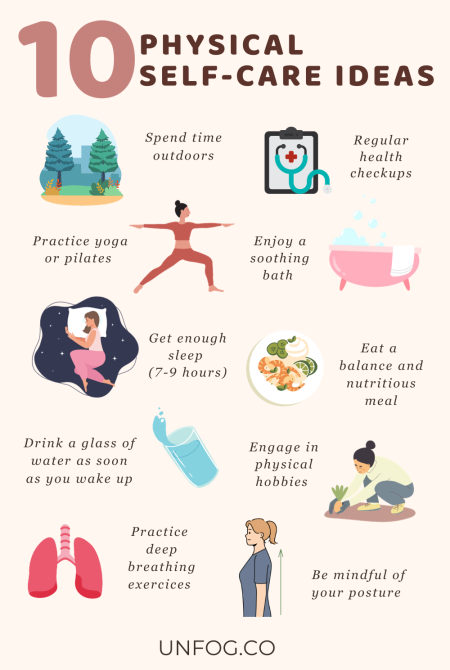
Here are some physical self-care activities to consider:
- Spend time outdoors, soaking in natural light and fresh air
- Regular health checkups
- Practice yoga or pilates
- Enjoy a soothing bath with epsom salts or bath bomb
- Get enough sleep (7-9 hours)
- Eat a balance and nutritious meal
- Drink a glass of water as soon as you wake up
- Engage in physical hobbies like gardening, dancing, or playing a sport
- Practice deep breathing exercices
- Be mindful of your posture, especially if you work at a desk
SAVE THESE PHYSICAL SELF-CARE IDEAS ON PINTEREST
2 | Emotional self-care
While physical self-care focuses on the body, emotional self-care centers on the mind and heart.
It’s about recognizing, acknowledging, and addressing your emotions in a healthy and constructive manner.
Emotional self-care starts with self-awareness. It’s about tuning in to your emotions, understanding their triggers, and learning to respond rather than react.
Mindfulness practices, such as meditation and journaling, can help you become more in tune with your emotional landscape.
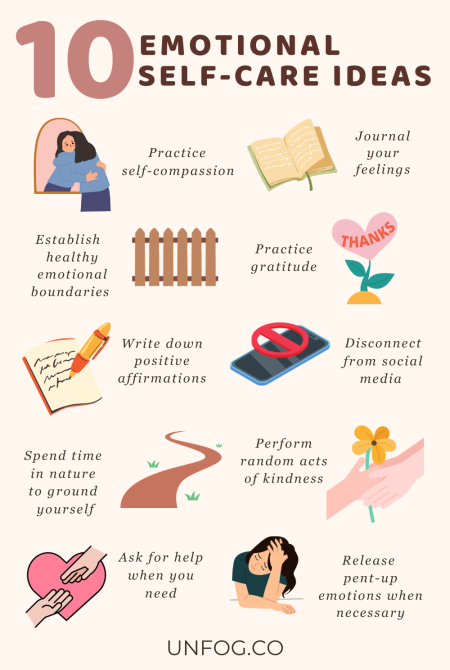
Here are some emotional self-care activities to consider:
- Journaling – Express your thoughts, feelings, and experiences
- Incorporate positive affirmations into your daily routine
- Emotional release – Allow yourself to cry, scream, or release pent-up emotions when necessary
- Establish and maintain healthy emotional boundaries in your relationships
- Disconnect from screens and social media to create mental and emotional space
- Perform random acts of kindness
- Spend time in nature to ground yourself
- Reach out to friends or family when you need emotional support
- Practice gratitude
- Practice self-compassion and self-kindness
SAVE THESE EMOTIONAL SELF-CARE IDEAS ON PINTEREST
3 | Social self-care
Human connection is essential for our well-being.
Social self-care is not just about maintaining relationships for the sake of it.
It involves recognizing the importance of healthy relationships in your life and actively taking steps to ensure that your social interactions positively contribute to your overall quality of life.
Healthy social interactions provide emotional support, reduce feelings of isolation, and enhance your overall well-being.
By prioritizing social self-care, you create a supportive network that empowers you to navigate life’s challenges with greater resilience and find joy in shared experiences and meaningful connections.
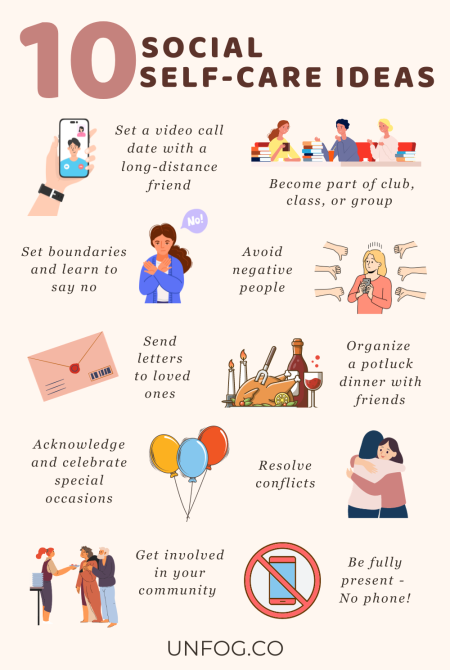
Here are some social self-care activities to consider:
- Set phone or video call dates with long-distance friends or family
- Become part of clubs, classes, or groups aligned with your interests
- Set boundaries and learn to say no
- Avoid negative people
- Arrange a potluck dinner or cooking session with friends
- Get involved in your community through local events, initiatives, or volunteering
- Acknowledge and celebrate special occasions, achievements, and anniversaries
- Conflict resolution – Address conflicts in a healthy and constructive way, prioritize open communication
- Be fully present – Hanging out with a friend with zero distractions
- Send handwritten letters or cards to loved ones
SAVE THESE SOCIAL SELF-CARE IDEAS ON PINTEREST
4 | Intellectual self-care
Stimulating your mind is crucial for personal growth, creativity, and cognitive well-being.
It’s an often-overlooked aspect of self-care that plays a vital role in enhancing your overall quality of life.
Intellectual Self-Care revolves around the cultivation of curiosity, the pursuit of knowledge, and the development of problem-solving skills.
Engaging in intellectual self-care activities, such as reading, engaging in stimulating discussions, pursuing hobbies that challenge the mind, and setting intellectual goals, enriches mental agility and fosters a deeper understanding of the world.
It’s a practice that not only sharpens cognitive abilities but also encourages exploration, innovation, and a lifelong commitment to intellectual growth.
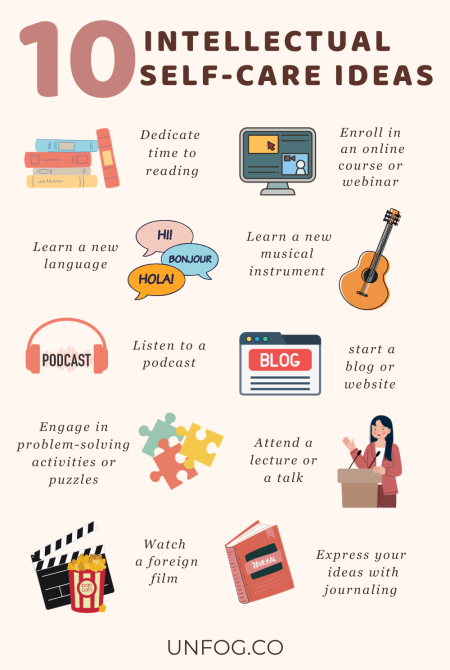
Here are some intellectual self-care activities to consider:
- Dedicate time to read a book, magazine, or article on topics that interest you
- Learn a new language
- Enroll in online courses or webinars
- Share your thoughts and expertise by starting a blog or website
- Listen to podcasts on diverse topics
- Challenge yourself to learn a new musical instrument or improve your existing skills
- Engage in problem-solving activities or puzzles
- Journaling – Express your thoughts, ideas, and experiences in a personal journal
- Watch a foreign film to gain cultural insights and explore different perspectives
- Attend a lecture or a talk – Participate in lectures, seminars, or TED talks on various subjects
SAVE THESE INTELLECTUAL SELF-CARE IDEAS ON PINTEREST
5 | Recreational self-care
In our whirlwind of responsibilities and never-ending to-do lists, we’ve come to appreciate the incredible value of recreational self-care.
Recreational self-care is all about rediscovering the simple joys and passions that often get buried beneath the daily grind. It’s about finding your inner child and simply have fun!
Life isn’t just about the tasks we need to complete; it’s also about the experiences we cherish.
The essence of recreational self-care is found in the opportunity to reconnect with the activities that brings you genuine happiness and relaxation.
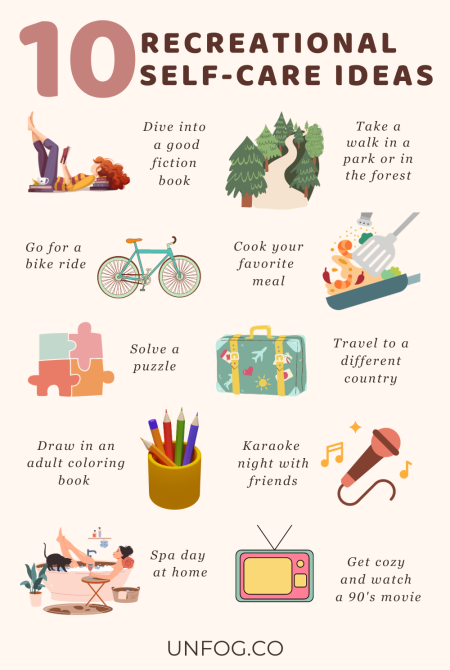
Here are some recreational self-care activities to consider:
- Dive into a good book
- Take a walks in a park or in the forest
- Go for a bike ride through your neighborhood or on scenic trails
- Cook and experiment with new recipes or bake your favorite treats
- Solve a puzzle and play a board game with friend or family
- Travel to explore a new place, even if they’re nearby, to experience new surroundings
- Be creative with adult coloring book
- Sing your heart out with friends during a karaoke night
- Create a spa day at home and relaxe
- Have a cozy night at home watching a 90’s movie
SAVE THESE RECREATIONAL SELF-CARE IDEAS ON PINTEREST
6 | Financial self-care
Financial self-care is about building a healthy relationship with money and making choices that align with your financial goals and values.
It involves taking deliberate steps to manage your finances in a way that supports your overall well-being and financial security.
It includes practices such as budgeting, saving, and investing wisely. This form of self-care emphasizes reducing and managing debt, ensuring that you have a financial safety net for emergencies, and making informed financial decisions.
It might seem boring, but by practicing financial self-care, you empower yourself to alleviate financial stressors, secure your future, and attain a sense of financial freedom that contributes to your peace of mind.
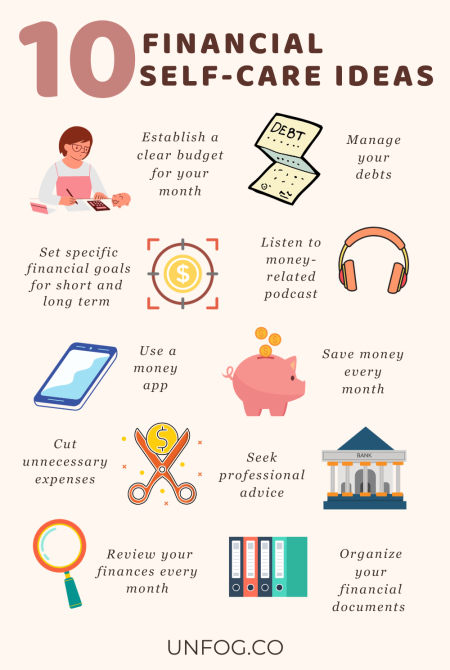
Here are some financial self-care activities to consider:
- Establish a clear budget that outlines your income and expenses
- Set specific savings goals for short-term and long-term objectives
- Listen to a financial podcast
- Develop a plan to pay down high-interest debt, such as credit card
- Explore financial apps that make saving and investing fun
- Save money every month
- Identify and cut expenses that are not essential, like unused gym memberships or subscriptions
- Consult a financial advisor or planner to help you make informed financial decisions
- Review your finances every month
- Organize your financial documents and eliminate unnecessary paperwork
SAVE THESE FINANCIAL SELF-CARE IDEAS ON PINTEREST
7 | Environmental self-care
Your surroundings play a pivotal role in your overall well-being.
We’ve learned that to truly flourish, we must find the right environment for ourselves, whether that means finding motivation in the vibrant energy of a co-working space or transforming a corner of your home into a calming home office.
Creating an environment that nurtures rather than hinders your focus is vital. If you’re working from home, think about establishing a dedicated workspace that’s distinct from your everyday living area. Personalize it with greenery or artwork to enhance its visual appeal.
Taking care of your environment is an important part of self-care. Maintaining clean, organized personal spaces can lead to a clutter-free mind, reducing stress and boosting your productivity.
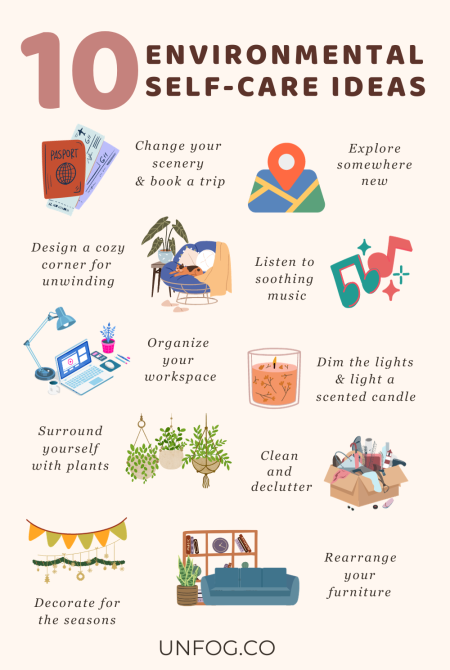
Here are some environmental self-care activities to consider:
- Change your scenery & book a trip
- Organize your workspace
- Regularly tidy your living spaces
- Surround yourself with plants
- Design a cozy corner for unwinding
- Listen to soothing music
- Exploring somewhere new
- Light a scented candle
- Decorate for the Seasons
- Rearrange your furniture
SAVE THESE ENVIRONMENTAL SELF-CARE IDEAS ON PINTEREST
Build a Self-Care Plan
Now that you’ve explored the various facets of self-care, it’s time to craft your own personalized self-care plan.
An effective self-care plan must be tailored to your life and needs. Just as no two individuals are exactly alike, no single self-care approach will fit everyone.
Self-care is a dynamic and personalized journey.
It’s about taking intentional steps to ensure that you are not only coping with the stress and challenges life presents but also thriving and finding fulfillment in the process.
Remember that self-care is an ongoing journey, and it’s perfectly normal to adapt and refine your plan as your needs evolve.
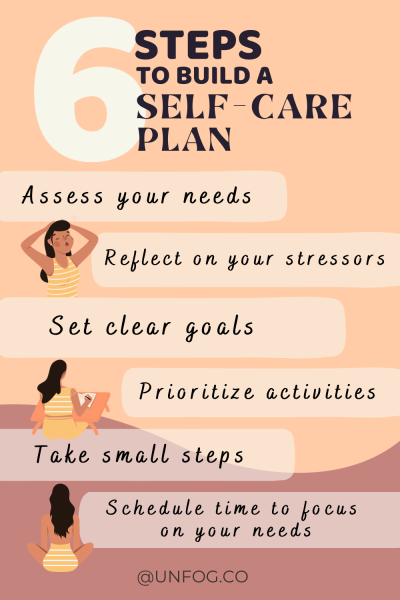
6 steps to create a self-care plan that is uniquely yours
1 | Assess your needs
Reflect on your well-being in different areas of your life, including physical, emotional, social, intellectual, career, financial, and environmental aspects. Identify the areas that require more care and balance.
2 | Reflect on your stressors
Take time to identify the stressors and challenges you regularly encounter in your life. Recognizing these stressors allows you to tailor your self-care plan to address them effectively.
It might be work-related stress, relationship challenges, financial pressures, or any other sources of tension. Understanding your stressors is essential to creating a plan that offers genuine relief.
3 | Set Clear Goals
Establish specific and achievable self-care goals for each area. Make sure they are measurable and time-bound, giving you a clear direction for improvement.
4 | Prioritize Activities
Determine self-care activities that align with your goals. These activities can range from meditation and mindfulness practices for emotional well-being to networking events or social outings for social well-being.
Prioritizing activities ensures you’re focusing your energy where it matters most.
5 | Take Small Steps
It’s important to understand that self-care is an ongoing process, and it’s often most effective when approached incrementally. Start by taking small steps toward your self-care goals.
For example, if your goal is to read more to enhance your intellectual well-being, begin with just 15 minutes of reading each day. Gradually increase the time as it becomes a consistent habit.
6 | Schedule Time to Focus on your Needs
To make self-care a consistent part of your life, schedule dedicated time for these activities. Treat these appointments with yourself as non-negotiable, just like any other commitment in your calendar.
SAVE THESE STEPS TO BUILD A SELF-CARE PLAN ON PINTEREST
The Final Word
Your self-care plan should be as unique as you are, customized to meet your specific needs and aligned with the demands of your daily life.
It’s not a one-size-fits-all strategy, but a dynamic approach encompassing physical, emotional, social, intellectual, career, financial, and environmental well-being.
Consider your current life circumstances. For example, if you are a young professional juggling a demanding career and family responsibilities, you might want to prioritize emotional self-care. On the other hand, if you are single individual embarking on a new career path, you may find that focusing on intellectual self-care is crucial to your personal growth.
The key is proactive, daily self-care. Waiting until you’re at your breaking point isn’t the objective. Instead, the goal is to take consistent, intentional steps to ensure you have the resilience and strength to navigate life’s stressors and challenges effectively.
Thank you for being here and see you in the next one! 🫶